Blog WeddingAI.video
How to Restore and Preserve Vintage Wedding Videos with AI
10 minutes de lecture
Somewhere in your parents' attic — or maybe your grandparents' closet — there's a box. Inside that box are tapes, film reels, or maybe even DVDs from weddings that happened decades ago. Weddings where the hairstyles were different, the music was different, and the fashion was *very* different. But the emotion? The tears during the vows, the laughter during the speeches, the joy on the dance floor? That's timeless.
The problem is, time hasn't been kind to that footage. Colors have faded. Images have degraded. Audio has become muffled. Some tapes have physical damage — warping, mold, or magnetic deterioration that makes them nearly unwatchable.
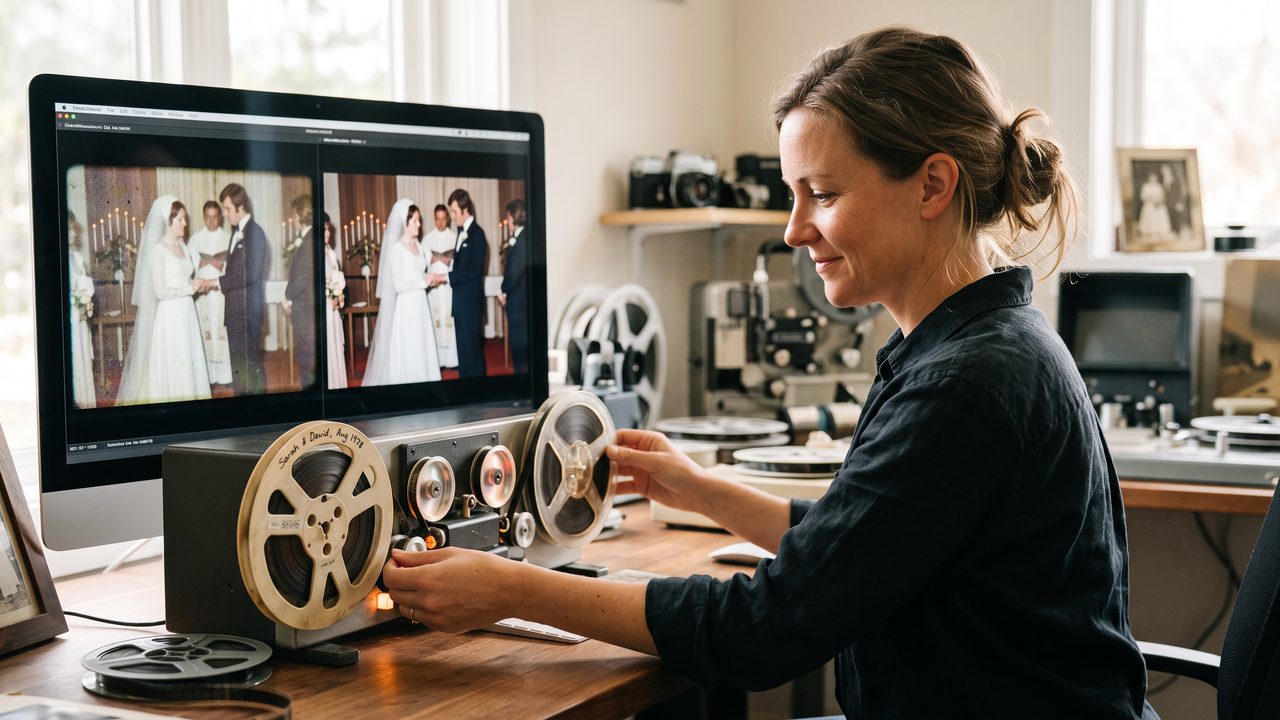
Until recently, professional film restoration was the exclusive domain of Hollywood studios with million-dollar budgets. But artificial intelligence has democratized this capability entirely. Today, AI can restore vintage wedding footage to a quality that often surpasses what it looked like when it was first recorded — and do it affordably, quickly, and without requiring any technical expertise.
The Problem with Old Wedding Footage
Understanding why vintage footage degrades helps explain why AI restoration is so transformative.
Physical Media Degradation
**VHS and Hi8 Tapes (1980s–2000s)**
Magnetic tape is inherently unstable. Over time, the magnetic particles that store your video signal lose their charge. Colors shift, contrast weakens, and tracking errors create horizontal lines across the image. Tape also physically stretches, and humidity can cause mold growth on the surface.
**Film Reels (1950s–1980s)**
8mm and 16mm film is vulnerable to color fading (especially the red and blue layers), vinegar syndrome (a chemical breakdown that causes warping and a distinct smell), and physical scratches from repeated projection.
**Early Digital (2000s–2010s)**
Even early digital formats have problems. MiniDV tapes suffer the same magnetic degradation as VHS. Early digital files were often recorded at low resolutions (320×240 or 640×480) with heavy compression, creating blocky, artifact-filled footage.
**DVDs (2000s–2010s)**
DVDs scratch, delaminate, and suffer disc rot. Even well-preserved DVDs max out at 480p standard definition — a resolution that looks painfully soft on modern 4K displays.
Common Quality Issues
- **Color fading** — Reds turn orange, blues turn gray, skin tones become greenish
- **Chroma noise** — Random colored specks throughout the image
- **Luminance noise** — Grain and snow, especially in low-light reception footage
- **Interlacing artifacts** — Horizontal combing lines from interlaced video formats
- **Low resolution** — Blocky, pixelated images that fall apart on large screens
- **Audio degradation** — Hiss, hum, dropout, and muffled dialogue
- **Tracking errors** — Horizontal distortion from worn VHS tapes
- **Dropout** — White or black streaks where data has been lost
How AI Vintage Restoration Works
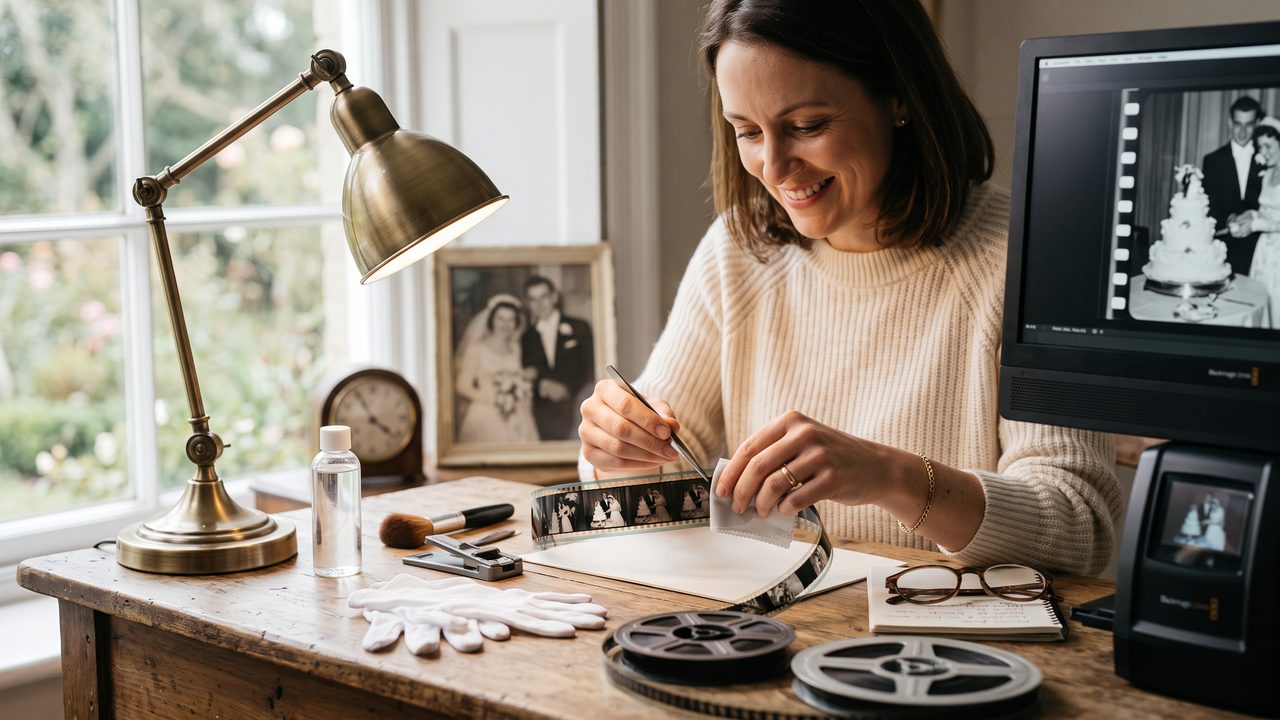
Traditional restoration involved painstaking frame-by-frame manual work. A single minute of footage could take hours to repair. AI has compressed this timeline from hours to minutes while producing results that often exceed manual methods.
The Restoration Pipeline
Our AI restoration process at WeddingAI follows a sophisticated multi-stage pipeline:
**Stage 1: Damage Assessment**
The AI scans the entire video, cataloging every type of degradation present. It creates a damage map that identifies:
- Scratch locations and trajectories
- Noise patterns and intensity
- Color shift magnitude
- Dropout and corruption zones
- Interlacing patterns
**Stage 2: De-interlacing and Format Conversion**
Legacy interlaced footage is converted to progressive scan using motion-adaptive algorithms that preserve detail while eliminating combing artifacts.
**Stage 3: Temporal Denoising**
Rather than processing each frame in isolation, the AI analyzes sequences of frames together. It distinguishes between actual image detail and random noise by tracking what persists across frames (detail) versus what flickers randomly (noise). This preserves fine details like lace patterns on wedding dresses while removing distracting grain.
**Stage 4: Color Restoration**
AI models trained on archival footage understand how different film stocks and tape formats fade over time. They can:
- Reconstruct faded color channels
- Correct white balance shifts
- Restore natural skin tones
- Recover color information that appears lost to the naked eye
**Stage 5: Super-Resolution Upscaling**
This is where the magic truly happens. AI super-resolution doesn't just stretch pixels — it *imagines* the missing detail based on learned patterns. A 480p wedding video can be upscaled to 1080p or even 4K with genuinely sharp, natural-looking results. The AI adds detail that's contextually appropriate: fabric texture, facial features, architectural details of the venue.
**Stage 6: Scratch and Artifact Removal**
For film-based footage, specialized neural networks detect and remove scratches, dust, and gate weave. For video-based footage, dropout streaks and tracking errors are repaired using temporal information from surrounding frames.
**Stage 7: Audio Restoration**
AI audio processing can:
- Remove tape hiss and hum
- Repair audio dropout
- Enhance dialogue clarity
- Normalize volume levels
- Reduce echo in reverberant church or hall recordings
**Stage 8: Frame Rate Stabilization**
Old footage often has inconsistent frame rates due to recording equipment limitations. AI stabilizes playback speed for smooth, consistent motion.
What Can Be Restored?
The short answer: almost anything with an image on it. Here's what we work with regularly:
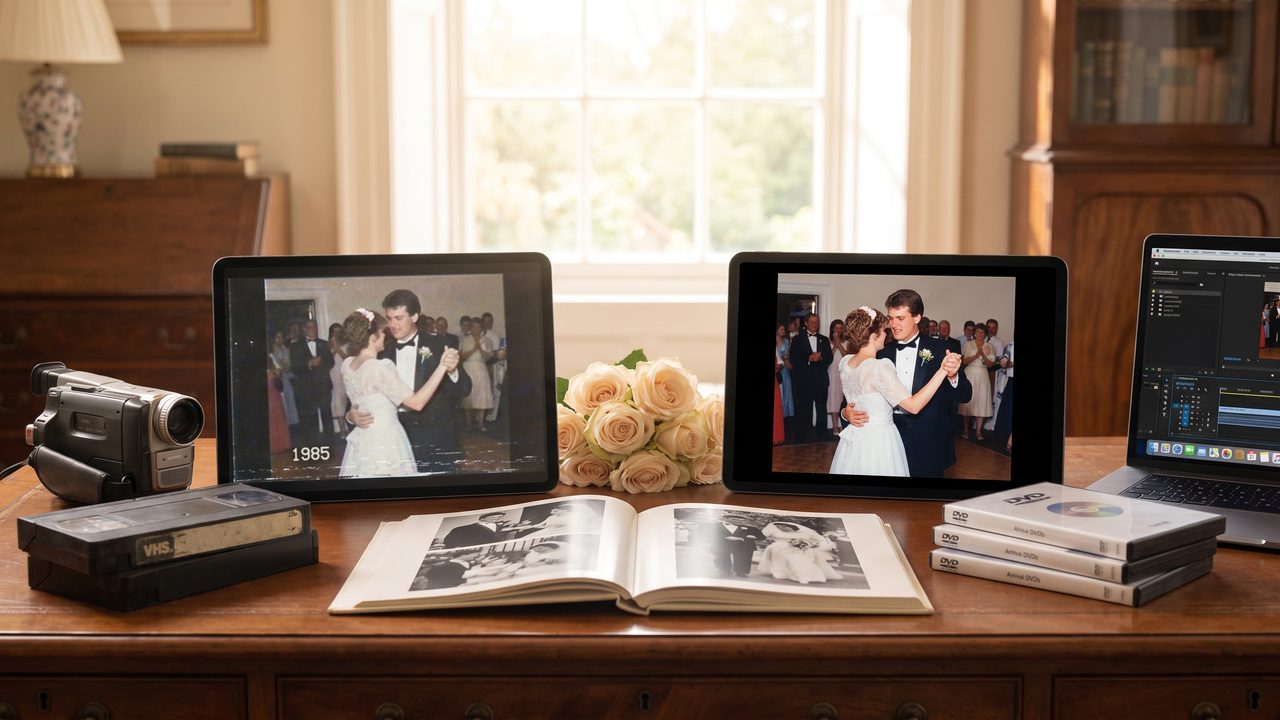
VHS / S-VHS / VHS-C
The most common format for weddings from the 1980s through early 2000s. Results are consistently good, even with significant degradation. Color correction and noise reduction produce dramatic improvements.
Hi8 / Video8 / Digital8
Slightly better quality than VHS at the source. Digital8 tapes in particular yield excellent restoration results because the digital signal, while degraded, hasn't undergone the analog-to-digital conversion artifacts of VHS.
MiniDV / DVCAM
Early digital formats with reasonable source quality. Main challenges are compression artifacts and low resolution. Upscaling results are typically very good.
8mm / Super 8 Film
Film restoration is particularly rewarding. The organic grain structure of film responds beautifully to AI processing. Colors can be vividly restored, and the natural film aesthetic — with just the right amount of grain preserved — creates a nostalgic, cinematic result.
16mm Film
Higher resolution than 8mm, producing restoration results that can rival modern footage. Some 16mm wedding films from the 1960s and 70s, once restored, look absolutely stunning.
Early Digital Files
Low-resolution digital files from early consumer cameras and camera phones. These benefit enormously from super-resolution upscaling.
DVDs and Blu-rays
Even standard DVDs can be upscaled to near-HD quality. Blu-rays generally need less work but can benefit from color correction and noise reduction.
The Emotional Impact of Restoration
Restoring vintage wedding video isn't just a technical exercise — it's an act of love with profound emotional consequences.
For Parents and Grandparents
> *"When I showed my mother her own wedding video — restored, clear, with actual color — she couldn't speak. She just held the screen and stared. She hadn't seen her father's face clearly in that video for twenty years. He passed in 2008. She watched it four times that evening."*
> — **Sarah Chen**, restored 1994 VHS wedding
Imagine watching your own wedding video for the first time in decades and being able to see it clearly — not through a haze of static and faded color, but sharp and vivid, as if it happened yesterday.
For Those Who've Lost Someone
Restored wedding footage often becomes the clearest video record of family members who've passed away. A grandmother's smile, a father's tears, an uncle's dance moves — these become priceless when they're the only moving images that remain.
For the Next Generation
Children and grandchildren who weren't alive when the wedding happened can now see it in quality that doesn't feel alien or unwatchable. A restored 1970s wedding video becomes something a teenager will actually sit through — and be moved by.
How WeddingAI Restores Your Vintage Footage
Our restoration process is designed to be simple for you while being technically sophisticated behind the scenes.
Step 1: Digitize (If Needed)
If your footage is on physical tape or film, you'll need to digitize it first. Options include:
- **Our mail-in digitization service** — Send us your tapes and film reels. We professionally digitize them at the highest possible quality before restoration begins
- **Local digitization services** — Many cities have shops that convert VHS/film to digital. Upload the digitized files to our platform
- **DIY capture** — If you have the equipment, capture at the highest quality settings your hardware supports
**Pro tip:** Always capture at the highest quality available, even if the source looks rough. Our AI works better with more raw data.
Step 2: Upload and Analyze
Upload your digitized footage to WeddingAI. Our system automatically:
- Identifies the source format and likely degradation types
- Assesses overall quality and damage severity
- Recommends the optimal restoration pipeline
- Provides a preview of expected results
Step 3: Choose Your Restoration Level
We offer three restoration intensities:
**Light Restoration** — For footage that's in decent shape but needs color correction, light denoising, and modest upscaling. Best for relatively well-preserved tapes from the late 1990s and 2000s.
**Full Restoration** — For significantly degraded footage with faded colors, heavy noise, and low resolution. Includes comprehensive color reconstruction, deep denoising, artifact removal, and substantial upscaling.
**Archival Restoration** — For severely damaged footage that may be the only copy in existence. Maximum processing intensity, including scratch repair, dropout reconstruction, and aggressive upscaling. Use this for irreplaceable film reels or badly damaged tapes.
Step 4: Preview and Refine
Before committing to full processing, you'll see a preview of the restoration on a representative segment. Adjust:
- Color warmth and saturation
- Noise reduction intensity (more reduction = cleaner but potentially softer)
- Sharpness level
- Grain preservation (some people prefer to keep a hint of the original grain for authenticity)
- Audio restoration level
Step 5: Full Processing and Delivery
Once you're happy with the preview settings, we process the complete video. Depending on length and restoration level, this typically takes 2–6 hours. You're notified when your restored video is ready for download in your choice of resolution (1080p or 4K).
Before and After: What to Expect
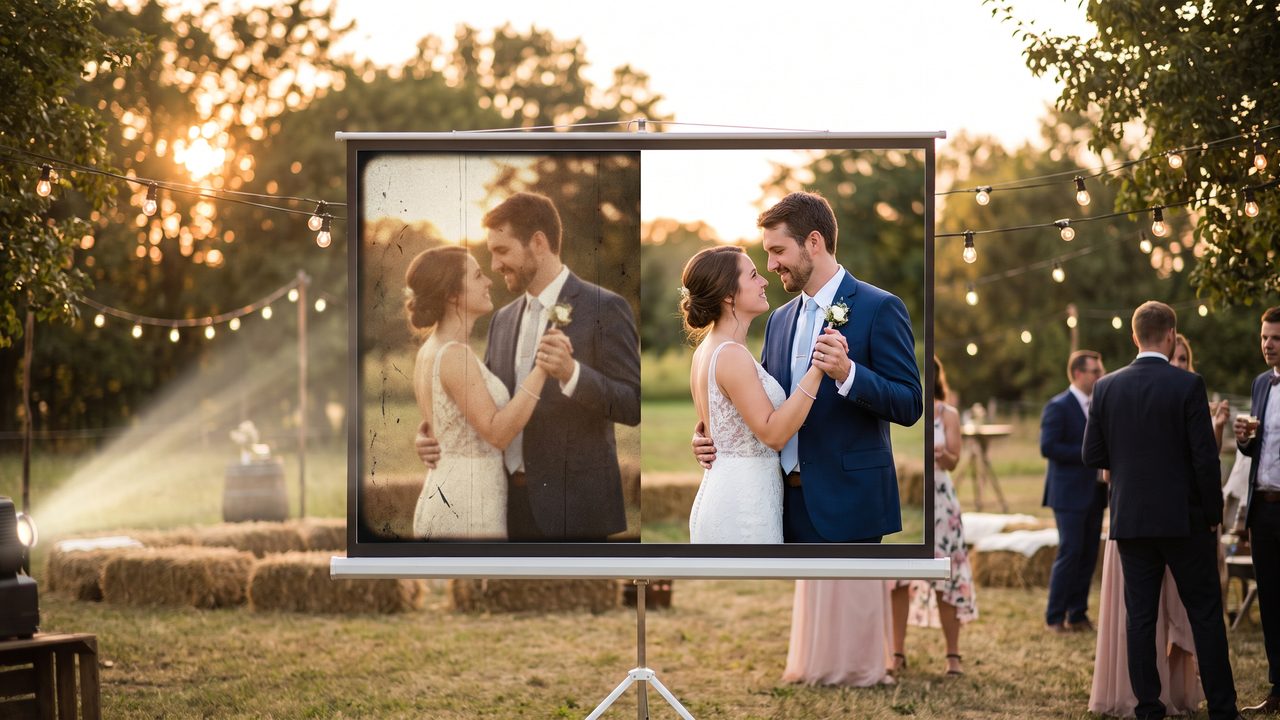
Restored footage doesn't look like it was shot yesterday — and that's intentional. Part of the charm of vintage wedding video is its era-specific aesthetic. Good restoration preserves the *feeling* of the original while removing the *damage*.
What Changes
- Colors become natural and balanced
- Noise and grain are reduced to pleasant levels
- Sharpness and detail improve dramatically
- Tracking errors and artifacts disappear
- Audio becomes clear and intelligible
What Stays the Same
- The overall aesthetic and mood of the era
- Film grain (at a reduced, pleasant level — if you want it)
- The authentic feel of the original recording
- Camera movement and framing
- The spontaneous, imperfect charm of home video
Our philosophy: restore, don't replace. Your vintage wedding video should look like the best possible version of itself, not like it was shot on a modern camera.
Combining Restoration with Other AI Features
Once your footage is restored, a world of creative possibilities opens up:
Create a Modern Highlight Reel
Use our AI Video Generator to create a polished highlight reel from restored footage, complete with music, transitions, and pacing that feels contemporary.
Add Slow Motion
Apply AI slow-motion enhancement to restored footage for dramatic effect. Imagine your grandmother's 1968 wedding recessional in gorgeous slow motion.
Build a Multi-Generational Video
Combine restored footage from your parents' or grandparents' wedding with your own. Our family tribute service can weave together footage from multiple generations into one moving narrative.
Create a Wedding Trailer
Use restored footage as the emotional core of a cinematic wedding trailer that spans generations.
> *"We restored my grandparents' 1962 Super 8 wedding film and combined it with footage from my parents' 1989 VHS wedding and our own 2025 wedding video. Three generations, one film. There wasn't a dry eye at our family reunion when we played it."*
> — **David & Amara Okafor**
Preserving Footage for the Future
Restoration is also an opportunity to create a proper digital archive. Here's how to protect your footage — both original and restored — for generations to come:
Storage Best Practices
- **Keep the originals** — Even after digitization, store physical tapes and film in a cool, dry, dark place
- **Multiple digital copies** — Store restored files in at least three locations: local drive, cloud storage, and an offsite backup
- **Use open formats** — Export in widely supported formats (MP4 with H.264/H.265) rather than proprietary codecs
- **Document the metadata** — Record who's in the video, the date, the venue, and any other context while people who remember are still alive
- **Check periodically** — Digital storage degrades too. Verify your files every few years and migrate to current storage media
The Race Against Time
Here's something most people don't realize: **footage degradation accelerates**. A VHS tape that's slightly faded today may be unwatchable in another decade. Magnetic tape has a practical lifespan of 15–30 years under ideal conditions — and attics and closets are far from ideal.
If you have vintage wedding footage in any format, the best time to digitize and restore it is *now*. Every year of delay means more irreversible quality loss.
Frequently Asked Questions
**Can badly damaged footage still be restored?**
In most cases, yes. Even footage with significant damage can be dramatically improved. However, some extreme damage (complete signal loss, severe mold penetration on tape) may only be partially recoverable. We always provide a free assessment before you commit.
**Will the restored video look "fake" or overly processed?**
No. Our restoration philosophy preserves the authentic character of the original footage. The goal is to remove damage and enhance quality while maintaining the genuine aesthetic of the era.
**How long does restoration take?**
Light restoration: 1–2 hours. Full restoration: 3–5 hours. Archival restoration: 4–8 hours. Times vary based on video length and damage severity.
**Can you restore audio from damaged tapes?**
Yes. Our AI audio restoration removes hiss, hum, and crackle while enhancing dialogue clarity. Severely damaged audio may still show some artifacts, but intelligibility is typically improved dramatically.
**What if I only have the physical tape and no way to play it?**
Use our mail-in digitization service. We have professional-grade playback equipment for all major tape and film formats and can handle even damaged or moldy tapes with specialized cleaning processes.
**Is there a limit to how old footage can be?**
We've successfully restored wedding footage from the 1950s. The limiting factor isn't age per se — it's the condition of the physical media and the quality of the original recording.
Bring Your Family's Wedding History Back to Life
Every family has wedding footage sitting in a box somewhere, slowly deteriorating. Every year that passes means more color fading, more degradation, more irreversible loss. The people in those videos — grandparents, parents, aunts, uncles, friends — their smiles, their tears, their dance moves deserve to be seen clearly.
AI restoration makes this possible in a way that was unimaginable even five years ago. What once required a Hollywood post-production budget can now be done from your laptop in an afternoon.
Don't let those memories fade away. Restore them, share them, and pass them down.
**Start Your Vintage Wedding Video Restoration →**
Upload your footage or request a free assessment today. Because the best time to save a memory is before it's gone.
Prêt à transformer vos souvenirs de mariage ?
Parlez-nous de votre projet et nous vous répondrons dans les 24 heures avec un devis gratuit.
Obtenez un devis gratuit →