Blog WeddingAI.video
Is AI-Generated Wedding Video Safe? Privacy Protection Guide
Worried about privacy with AI wedding video tools? Learn how your photos and data are protected, what to look for, and how to keep your wedding memories safe.
10 minutes de lecture
Your wedding photos and videos are among the most personal, intimate content you'll ever create. They capture your most vulnerable moments — tears of joy, private vows, emotional family interactions. The idea of uploading all of that to an AI platform might feel uncomfortable. Where does your data go? Who can see it? Is it used to train AI models? What happens if the platform gets hacked?
These are valid concerns, and they deserve honest answers. This guide will help you understand the privacy implications of AI wedding video tools and give you practical steps to protect your data.
The Privacy Landscape in 2026
Let's start with the big picture. The AI industry's approach to data privacy has evolved significantly over the past few years. In the early days of AI image and video generation, data practices were often murky. Companies trained models on user-uploaded content without clear consent, data retention policies were vague, and security measures were inconsistent.
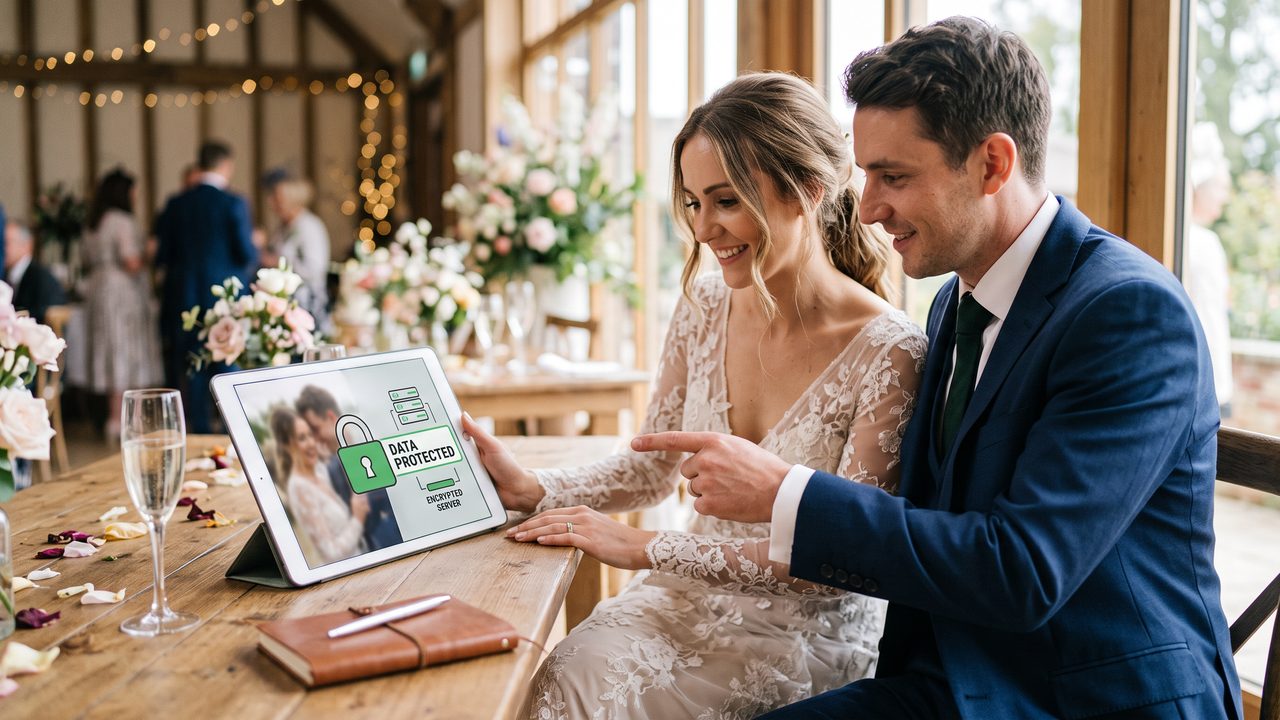
By 2026, the landscape has matured considerably:
**Regulations have tightened.** GDPR in Europe, CCPA in California, and similar laws worldwide now require clear consent for data collection, purpose limitation, and the right to deletion. Reputable AI platforms comply fully with these regulations.
**Industry standards have emerged.** The AI video generation industry has developed best practices for data handling, including encryption, access controls, retention limits, and transparency requirements.
**Consumer awareness has increased.** People are more informed about data privacy and demand better protections from the platforms they use.
That said, not all platforms are equal. It's important to understand what to look for and what questions to ask.
What Happens to Your Data When You Upload It?
When you upload photos and videos to an AI wedding video platform, several things happen:
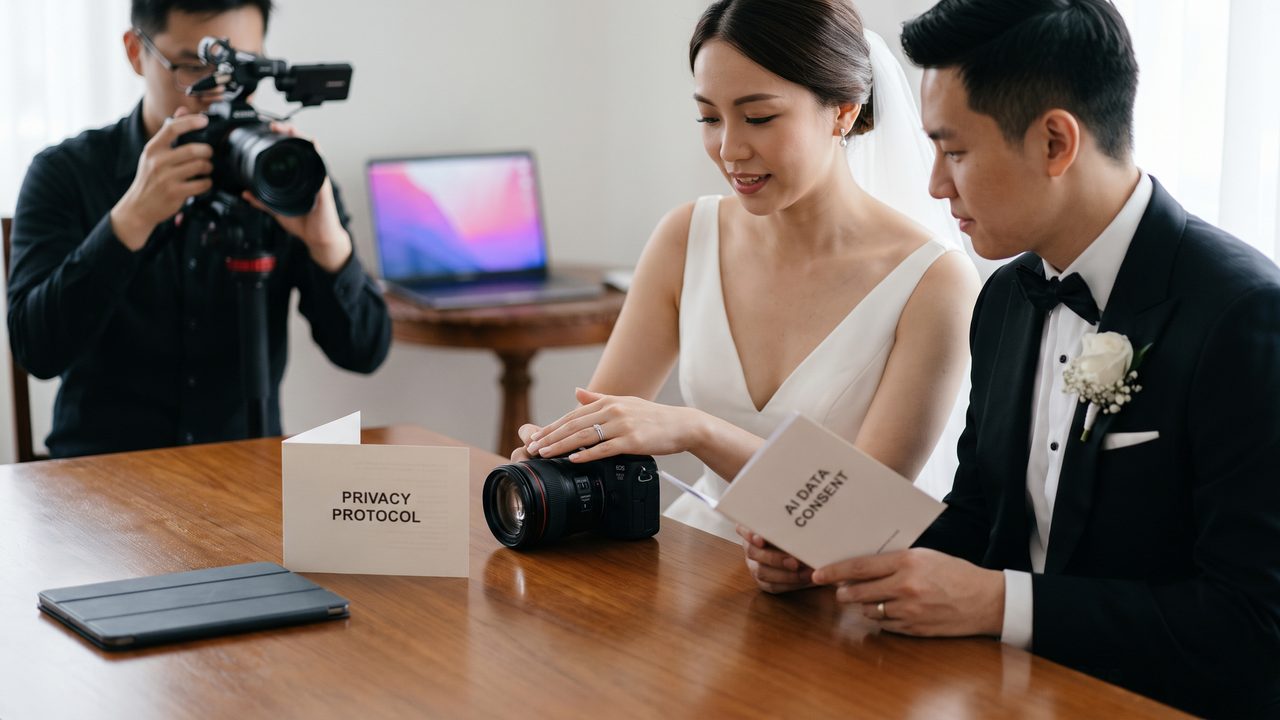
Processing
Your content is processed by AI algorithms to create your video. This typically involves:
- Analyzing images for content, faces, and quality
- Generating animations and effects
- Assembling the final video
This processing happens on secure servers. Your content is transmitted over encrypted connections (HTTPS/TLS) and stored temporarily on secure infrastructure.
Temporary Storage
Your uploaded content and the generated video are stored on the platform's servers for a period of time. This allows you to:
- Access your project across sessions
- Make revisions and adjustments
- Download your finished video multiple times
- Share links with family members
Deletion
Reputable platforms have clear data retention policies. After a defined period (typically 30-90 days), your uploaded content and generated videos are automatically deleted from their servers. You should also have the ability to manually delete your data at any time.
Key Privacy Questions to Ask
Before using any AI wedding video platform, ask these questions:
1. Is my content used to train AI models?
This is the most important question. Some platforms use uploaded content to improve their AI models. This means your wedding photos could become part of a training dataset that influences future AI outputs.
**What to look for:** A clear statement that your content is NOT used for AI training without explicit consent. The best platforms have an opt-in policy where you can choose to contribute your data for model improvement, but it's never the default.
2. Who can see my content?
Understand who has access to your uploaded photos and generated videos:
- **Platform employees:** Can staff members view your content? Under what circumstances?
- **Third parties:** Is your data shared with any third parties for processing, analytics, or marketing?
- **Other users:** Is there any scenario where other users could access your content?
**What to look for:** A clear privacy policy that limits access to your content. Ideally, no human should ever view your content unless you specifically request support.
3. How is my data encrypted?
Your data should be encrypted both in transit (when uploading/downloading) and at rest (when stored on servers).
**What to look for:** HTTPS for all web interactions, AES-256 encryption for stored data, and encrypted backups.
4. How long is my data retained?
Understand the platform's data retention policy:
- How long are uploaded photos stored?
- How long are generated videos available?
- Can you request early deletion?
- What happens to your data if you delete your account?
**What to look for:** Clear retention periods (30-90 days is standard), manual deletion options, and automatic expiration.
5. Where is my data stored?
Data location matters for legal protection. Data stored in the EU is protected by GDPR. Data in the US is subject to different regulations.
**What to look for:** Clear disclosure of data center locations and compliance with relevant privacy laws.
6. What happens if there's a data breach?
Understand the platform's security measures and breach notification procedures.
**What to look for:** Security certifications (SOC 2, ISO 27001), regular security audits, and a clear breach notification policy.
For a comprehensive overview of these issues, see our complete guide to AI wedding video privacy.
Red Flags: What to Avoid
Watch out for these warning signs:
**No privacy policy.** If a platform doesn't have a clearly accessible privacy policy, don't use it. Period.
**Vague language.** Phrases like "we may use your data to improve our services" without specifics are red flags. Demand clarity.
**No deletion option.** If you can't delete your data, your content could be stored indefinitely. Avoid platforms without clear deletion mechanisms.
**Unsecured connections.** If the website doesn't use HTTPS (look for the padlock icon in your browser), your data is transmitted in plain text and could be intercepted.
**No contact information.** Legitimate platforms provide clear contact information, including a physical address and support email. Anonymous platforms are risky.
**Too-good-to-be-true pricing.** If a platform offers professional-quality AI video generation for free with no clear business model, your data is probably the product. Be cautious.
Privacy Best Practices for Couples
Beyond choosing a reputable platform, here are practical steps you can take to protect your wedding content:
Before Uploading
- **Read the privacy policy.** Yes, actually read it. Look for the specific points mentioned above.
- **Check reviews.** See what other users say about the platform's privacy practices. Look for any reported incidents.
- **Use a strong password.** Create a unique, complex password for your account. Enable two-factor authentication if available.
- **Review permissions.** Understand what the platform's mobile app (if applicable) accesses on your device.
While Using the Platform
- **Upload only what you need.** Don't upload your entire photo library. Curate the specific photos and clips you want in your video.
- **Be mindful of sensitive content.** Consider whether certain intimate moments need to be in the video. You can always create a private version for yourselves and a less personal version for sharing.
- **Use privacy settings.** If the platform offers privacy settings for your project (public, unlisted, private), use them appropriately.
- **Avoid public sharing of raw uploads.** Share the finished video, not the upload link that gives access to your raw content.
After Creating Your Video
- **Download and store locally.** Don't rely solely on the platform to store your video. Download it and save it in multiple locations.
- **Delete your project from the platform.** Once you've downloaded your video, delete the project from the platform to remove your data from their servers.
- **Monitor your account.** Periodically check your account for any unauthorized access or unusual activity.
How WeddingAI.video Handles Privacy
At WeddingAI.video, we take privacy seriously. Here's how we protect your data:
**No AI training without consent.** We never use your uploaded content to train our AI models without your explicit, opt-in consent. Your wedding photos are yours.
**End-to-end encryption.** All data is encrypted in transit (TLS 1.3) and at rest (AES-256). Your content is protected at every stage.
**Limited access.** No human employee can access your uploaded content unless you specifically request technical support. All processing is automated.
**Automatic deletion.** Uploaded content is automatically deleted 60 days after your last access. You can also manually delete your data at any time with a single click.
**GDPR and CCPA compliant.** We fully comply with all major privacy regulations and provide clear data export and deletion tools.
**SOC 2 certified.** Our infrastructure meets the highest security standards, with regular third-party audits.
Special Privacy Considerations
Guest Privacy
Your wedding video likely includes other people — guests, family members, vendors. Consider their privacy too:
- **Get consent** for close-up shots of guests before including them in shared videos
- **Offer opt-outs** for guests who don't want to appear in public-facing content
- **Be thoughtful about children** — consider whether kids should be in videos shared publicly on social media
Vendor Privacy
Your wedding vendors (photographer, DJ, planner) may have policies about how their work is used. Check with your photographer before using their images in AI-generated videos, especially if you plan to share publicly.
Social Media Sharing
When sharing wedding videos on social media:
- Use privacy settings to control who can see your content
- Consider who's in the video and whether they'd be comfortable with public sharing
- Be aware that once something is shared publicly, you lose control over how it's used
- Consider creating separate versions: a private one for family and a public one for social media
For more on creating shareable content, see our guide on wedding trailers for social media.
The Future of AI Privacy
The AI industry is moving toward stronger privacy protections:
- **Federated learning** allows AI to improve without centralizing user data
- **On-device processing** keeps data on your own device rather than uploading to servers
- **Zero-knowledge architectures** allow platforms to process data without ever "seeing" it
- **Blockchain-based verification** provides transparent, auditable data handling
These technologies are still developing but will significantly enhance privacy in the coming years.
The Bottom Line
AI wedding video tools are safe to use when you choose reputable platforms and follow basic privacy best practices. Your wedding content is precious, and it deserves to be treated with care — by you and by the platforms you use.
Don't let privacy concerns stop you from creating a beautiful wedding video. Instead, use this guide to make informed decisions and protect your data every step of the way.
Create Your Video with Confidence
Ready to create your wedding video knowing your privacy is protected?
**Try WeddingAI.video →** — where your wedding memories are safe, secure, and treated with the care they deserve.
Prêt à transformer vos souvenirs de mariage ?
Parlez-nous de votre projet et nous vous répondrons dans les 24 heures avec un devis gratuit.
Obtenez un devis gratuit →