

WeddingAI.video Blog
Wedding Video Audio Fix — Muffled Vows to Clear in 1 Click
Fix noisy wedding video audio with proven tools and techniques. Remove wind, chatter, and echo from your wedding footage. Get clear audio today!
8 min read · Updated 2026-10-13
Nothing ruins a beautiful wedding video faster than muffled vows buried under wind noise, or a first dance soundtrack competing with a rumbling air conditioner. Bad audio is the number one quality issue couples face with their wedding footage — and unlike shaky video, you can't just crop it out. The good news? Modern tools can rescue even the noisiest wedding audio, and you don't need to be a sound engineer to use them.
Why Wedding Audio Is So Difficult to Capture
Weddings are an acoustic nightmare. Professional videographers know this and come prepared with external microphones, wind screens, and backup audio recorders. But even the best equipment faces challenges at a typical wedding:
Environmental Noise
Outdoor ceremonies battle wind, traffic, birds, and construction. Indoor venues echo, hum with HVAC systems, and amplify every chair scrape and cough. Beach weddings are particularly brutal — ocean waves create constant low-frequency noise that swallows speech.
Distance Issues
The officiant and couple are usually positioned far from where the videographer can place a microphone. Even with wireless lavalier mics, signal interference and distance create audio degradation. If your videographer placed a mic on the officiant but the groom whispered his vows, you might barely hear them.
Crowd Noise
Guests aren't recording studios. They cough, whisper, rustle programs, and shuffle feet. During emotional moments, you might hear crying, laughing, or applause that drowns out the actual ceremony audio. Children are particularly unpredictable audio sources.
Equipment Limitations
Not every wedding has a professional videographer. Many couples rely on phone recordings from guests, GoPro cameras, or basic DSLR microphones. These built-in mics are designed for general use, not capturing clear speech at 50 feet in windy conditions.
Assessing Your Wedding Video Audio Problems
Before you fix your audio, you need to diagnose the specific issues. Play your wedding video and listen for these common problems:
Wind noise— A low rumbling or whooshing sound, especially in outdoor footage. It typically sits in the low frequencies (below 200 Hz) and can be reduced significantly.
Background chatter— Guest conversations, especially during quieter ceremony moments. This is harder to remove because human voices overlap in frequency range.
Echo and reverb— A hollow, bouncing sound common in large indoor venues, churches, and banquet halls. The audio sounds distant or "swimmy."
Hum and buzz— Constant, steady tones from electrical equipment, lighting rigs, or HVAC systems. Usually at 50/60 Hz and their harmonics. This is the easiest noise to remove.
Clipping and distortion— Harsh, crackling sounds that occur when audio levels were too high during recording. This is the hardest problem to fix because the original audio data is permanently damaged.
Free Tools for Wedding Video Audio Repair
You don't need expensive software to improve your wedding audio. Here are the best free options:
Audacity
noise reduction featureworks by sampling a "noise profile" (a section of pure background noise) and then subtracting that profile from the entire audio track.
How to use Audacity for noise reduction:
- Extract the audio from your video file
- Select a 2-3 second section where only the background noise is audible (no speech)
- Go to Effect → Noise Reduction → "Get Noise Profile"
- Select the entire audio track
- Apply noise reduction with settings: 12 dB reduction, 6 sensitivity, 3 smoothing
- Preview and adjust until the noise is reduced without making voices sound robotic
- Export the cleaned audio and re-sync with your video
DaVinci Resolve (Fairlight Audio)
Most people know DaVinci Resolve as a free video editor, but its Fairlight audio tab is a professional-grade audio workstation. It includes built-in noise reduction, equalization, and dynamics processing that rivals paid software.
Adobe Podcast (Enhance Speech)
Adobe's free web-based tool uses AI to enhance speech clarity. Upload your audio, and it processes the entire track, reducing background noise while boosting voice clarity. It works remarkably well on ceremony audio, though it can sound slightly artificial on music-heavy sections.
Professional Tools for Serious Audio Repair
If free tools don't cut it, these professional options deliver superior results:
iZotope RX
The industry standard for audio repair. iZotope RX includes specialized modules for de-noise, de-reverb, de-wind, and de-hum. Its spectral editing view lets you visually identify and remove specific sounds — like a cough during vows — without affecting the surrounding audio.
The Elements version (around $30) handles most wedding audio issues. The Standard version ($300) adds advanced features for severe problems.
Adobe Audition
Part of the Creative Cloud suite, Audition offers excellent noise reduction with its "Adaptive Noise Reduction" effect. It automatically adjusts to changing noise levels, which is useful for wedding audio where the background noise varies throughout the ceremony.
Final Cut Pro / Logic Pro
Mac users can leverage Apple's built-in audio repair tools. Logic Pro includes noise gates, spectral editing, and AI-powered audio enhancement that integrates seamlessly with Final Cut Pro video editing.
Step-by-Step: Fixing Common Wedding Audio Issues
Let's walk through fixing the three most common wedding audio problems.
Removing Wind Noise
Wind noise is low-frequency energy that masks speech. Here's the approach:
- Apply a high-pass filterat 80-100 Hz to cut the lowest rumbling frequencies. This won't affect speech, which primarily lives between 300 Hz and 3 kHz.
- Use a de-wind pluginif available (iZotope RX has a dedicated module).
- Apply gentle noise reductiontargeting the wind frequency range.
- Boost the voice frequencies(1-4 kHz) slightly to improve clarity.
Reducing Background Chatter
Crowd noise is trickier because it shares frequencies with the sounds you want to keep:
- Use a noise gateto reduce audio during silent moments (between sentences, pauses).
- Apply spectral noise reductioncarefully — too much processing makes voices sound underwater.
- Consider isolating specific momentsrather than processing the entire track. Sometimes it's better to clean just the vows and first dance than to over-process everything.
Fixing Echo and Reverb
Reverb is the hardest common issue to fix because it's not technically "noise" — it's the desired audio bouncing off walls:
- Use a de-reverb plugin(available in iZotope RX and Adobe Audition).
- Apply gentle compressionto bring quiet parts closer in volume to loud parts.
- Add subtle warmthwith a slight boost around 200-400 Hz to counteract the thin, distant sound that heavy reverb creates.
When DIY Audio Repair Isn't Enough
Some audio problems are beyond what software can fix:
- Severely clipped audiowhere the waveform is flat-topped
- Speech that's completely inaudibleunder competing noise
- Audio dropoutswhere the recording simply cuts out
- Multiple overlapping speakerswith no clean audio to work with
fixing shaky wedding videocovers similar recovery techniques for video quality issues.
video enhancement servicesinclude professional audio cleanup as part of our processing pipeline. Our AI can separate speech from noise, enhance clarity, and balance audio levels automatically.
Preventing Audio Problems in Future Videos
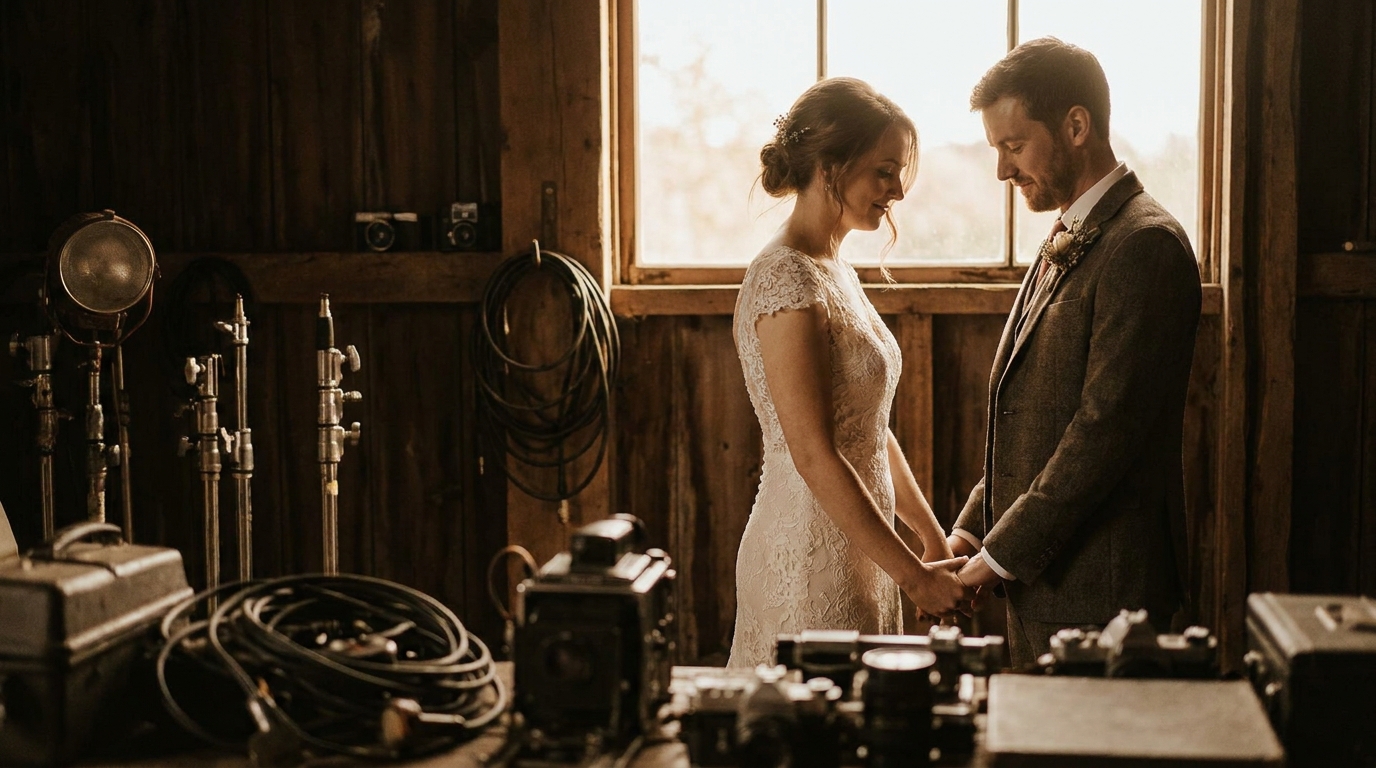
The best audio fix is preventing problems before they happen. If you're planning a wedding or helping someone who is:
For Outdoor Ceremonies
- Use a wireless lavalier microphoneon the officiant and one on the groom
- Position a shotgun microphoneas close to the couple as possible
- Choose a wind-protected location— near a building wall or under a structure
- Have a backup audio recorderplaced near the ceremony area
For Indoor Ceremonies
- Request access to the venue's sound systemand tap into the direct audio feed
- Place a recorder near speakersif the venue uses a PA system
- Test audio levelsduring the rehearsal
- Bring acoustic panelsif the venue is particularly echoey
For DIY and Phone Recordings
- Use an external microphonethat plugs into your phone (Rode, Shure, and Boya all make affordable options)
- Record in airplane modeto prevent notification sounds
- Hold the phone horizontallyand keep it steady
- Record multiple takesfrom different positions
The AI Approach to Wedding Audio Enhancement
AI-powered audio tools are revolutionizing how we fix wedding video audio. Unlike traditional noise reduction, which subtracts noise from the signal, AI tools can:
- Separate speech from noiseusing neural networks trained on millions of audio samples
- Reconstruct damaged audioby predicting what the clean signal should sound like
- Balance multiple audio sourcesautomatically
- Enhance voice claritywithout introducing artifacts
WeddingAI.video uses AI audio processing that can recover audio from footage most traditional tools would give up on. The technology analyzes your specific noise patterns and applies targeted corrections rather than blanket processing.
AI wedding video industry trends.
📸 Image Suggestion 1: A side-by-side comparison showing noisy ceremony audio waveform vs. cleaned audio waveform. Alt text: "wedding video audio fix before and after noise reduction"
📸 Image Suggestion 2: A person using Audacity software on a laptop to edit wedding ceremony audio. Alt text: "remove noise from wedding video using free audio editing software"
Frequently Asked Questions
Can I fix wedding video audio on my phone?
Yes. Apps like Dolby On, Voloco, and Ferrite Recording Studio offer basic noise reduction and audio enhancement on mobile devices. For simple wind or background hum removal, these apps work surprisingly well.
Will noise reduction make my audio sound robotic?
Over-processing can create artifacts that sound metallic or robotic. The key is subtlety — apply noise reduction gently and stop before the voice starts sounding unnatural. Less is more with audio repair.
How much does professional wedding audio repair cost?
Professional audio repair services typically charge $50-$200 per hour, with most wedding ceremony audio taking 2-4 hours to clean up properly. AI-powered services like WeddingAI.video offer more affordable options as part of video processing packages.
Can AI completely remove background noise from my wedding video?
AI tools are remarkably effective at separating speech from background noise, but they're not magic. If the noise completely drowns out the speech, even AI can only do so much. Early intervention (cleaning audio before further editing) produces the best results.
Should I fix the audio myself or hire a professional?
For basic noise issues (wind, hum, light chatter), DIY tools like Audacity work well. For severe problems (heavy reverb, multiple noise sources, very quiet speech), professional tools or services deliver noticeably better results.
Get Crystal-Clear Wedding Audio Without the Hassle
Don't let bad audio ruin your wedding memories. Whether you're dealing with wind noise, background chatter, or echoey venue acoustics, the right tools can transform muffled footage into a clear, emotional wedding film.
Upload your wedding video todayand hear the difference.
Ready to Transform Your Wedding Memories?
Tell us about your project and we'll get back within 24 hours with a free quote.
Get a Free Quote →